Wall-Temperature Effects on Mach 2.95 Shock/Boundary Layer Interaction Turbulence Characteristics
Abstract
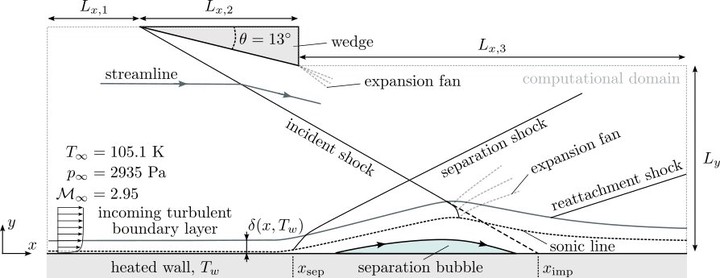
Shock/boundary layer interactions (SBLIs) are a major source of flow distortion and unsteady loads in high-speed aerodynamic systems. Although their mean features are well documented, the detailed behavior of turbulent fluctuations through and after the interaction remains insufficiently characterized, particularly under nonadiabatic wall conditions. This study investigates the turbulence characteristics of a $\mathcal{M}_{\infty} = 2.95$ SBLI generated by an oblique shock from a $13^{\circ}$ wedge over wall-to-recovery temperature ratios from 1.00 to 2.00, using particle image velocimetry and complementary Reynolds-averaged Navier–Stokes simulations. The investigation reveals that wall heating redistributes the vortex population within the separation zone and widens the turbulent cascade range. Analysis of turbulent kinetic energy indicates that wall heating reshapes the anisotropy of the Reynolds stress tensor without substantially altering the total kinetic energy level. Correspondingly, the energy spectra exhibit an increasingly wide deviation from the theoretical slope under heating, while the spectral anisotropy peak diminishes, reflecting the redistribution of turbulent energy.